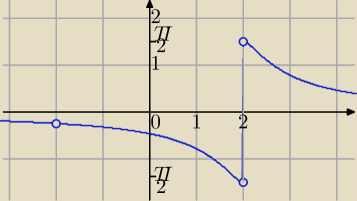
| x5 − 1 | ||
a) f(x) = | ||
| x4 − x2 − 4 |
| ln(1 + ex2+1) | ||
b) f(x) = | ||
| x |
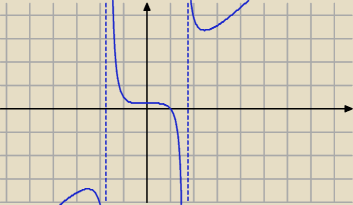 x4−x2−4=0
| √1+√17 | √1+√17 | |||
x1= | ≈1,6 lub x2=− | ≈−1,6 | ||
| √2 | √2 |
| −1 | 1 | |||
f(0)= | = | |||
| −4 | 4 |
| √1+√17 | ||
x= | ||
| √2 |
| √1+√17 | ||
x=− | ||
| √2 |
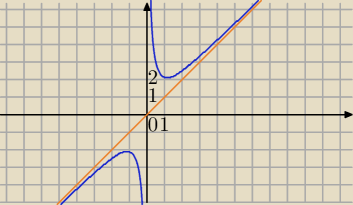 Jest tam asymptota ukośna w (a), ale musisz obliczyć granice
y=x
b)
x≠0
x=0 asymptota pionowa
Asyptoty ukośne :
Jest tam asymptota ukośna w (a), ale musisz obliczyć granice
y=x
b)
x≠0
x=0 asymptota pionowa
Asyptoty ukośne :
| ln(1+ex2+1 | ||
limx→∞ | =1 ( H) | |
| x2 |
| ln(1+ex2+1 | ||
b=lim{x→∞}[x− | ]=0 | |
| x |