| ⎧ | sinx gdy x<0 | ||
| f(x) = | ⎨ | ||
| ⎩ | ax2+bx gdy x≥0 |

 dla x < 0: f(x) = sinx, f'(x) = cosx, f'(0) = cos0 = 1
dla x ≥ 0: f(x) = ax2 + bx, f'(x) = 2ax + b, f'(0) = b
dla x = 0: cosx = 2ax + b ⇒ 1 = b i a∊R
dla x ≥ 0: f(x) = ax2 + x,
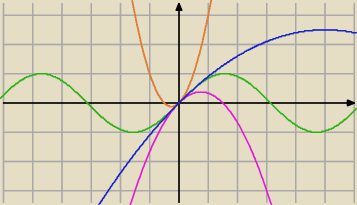
np.: f(x) = 2x2 + x (pomarańczowy wykres),
dla x < 0: f(x) = sinx, f'(x) = cosx, f'(0) = cos0 = 1
dla x ≥ 0: f(x) = ax2 + bx, f'(x) = 2ax + b, f'(0) = b
dla x = 0: cosx = 2ax + b ⇒ 1 = b i a∊R
dla x ≥ 0: f(x) = ax2 + x,
np.: f(x) = 2x2 + x (pomarańczowy wykres),
| 2 | ||
f(x) = − | x2 + x (różowy wykres), | |
| 3 |
